Commercial Planning Workbook
A workbook that turns a corporate growth framework into a repeatable commercial-planning cadence for sales leaders.
Across a decentralized network of roughly 40 industrial operating companies, commercial planning lived in each sales leader's head, run differently at every company, and surfaced once a year as opinion rather than pipeline intelligence. The field had asked for a template. This workbook answered with something more durable: a common planning methodology that makes every leader's plan legible, comparable, and coachable across the network. It guides a leadership team through three structured working sessions that ladder toward one output, a complete 2027 Commercial Plan tied to a 12% growth target, ready to defend at the September Summit.
Three design decisions that make it a sharper commercial tool:
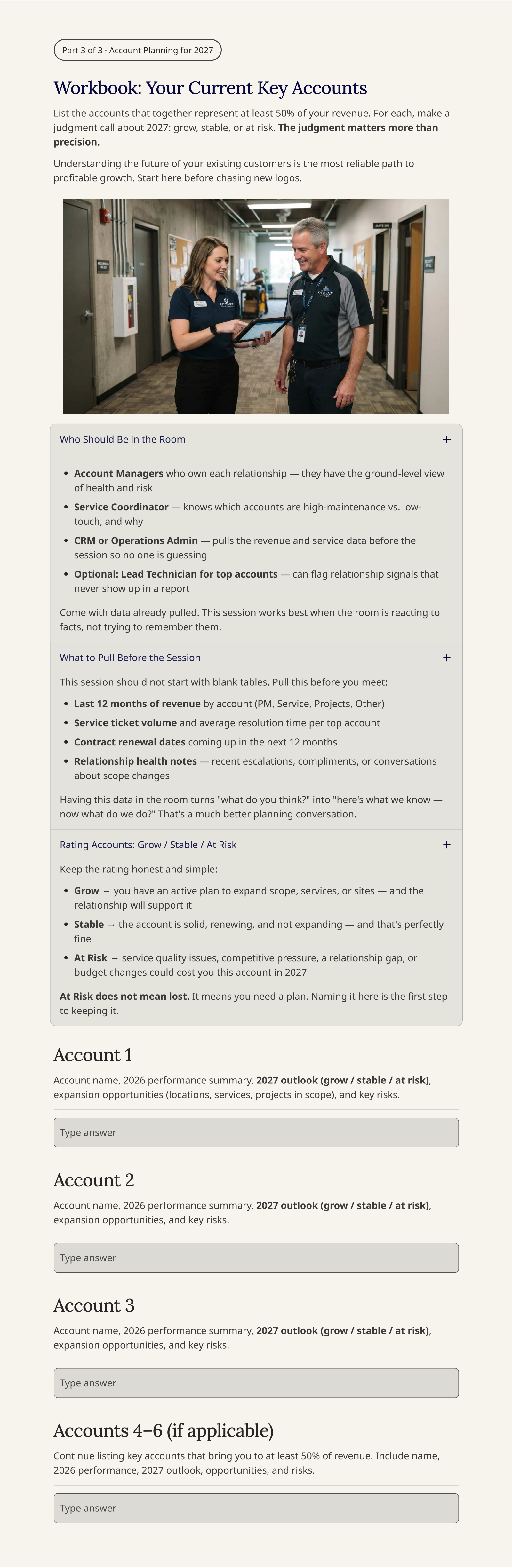
1. Planning happens against real accounts and real data, in a live working session. Each part opens with "Who Should Be in the Room" and a timed run-of-show that pulls account managers, operations, and field reps into the same conversation, with the instruction to come with revenue and pipeline data already pulled. This turns "what do you think?" into "here's what we know, now what do we do?" The session works the actual book of business, not a hypothetical one, so the plan that comes out is resourced and defensible rather than aspirational.
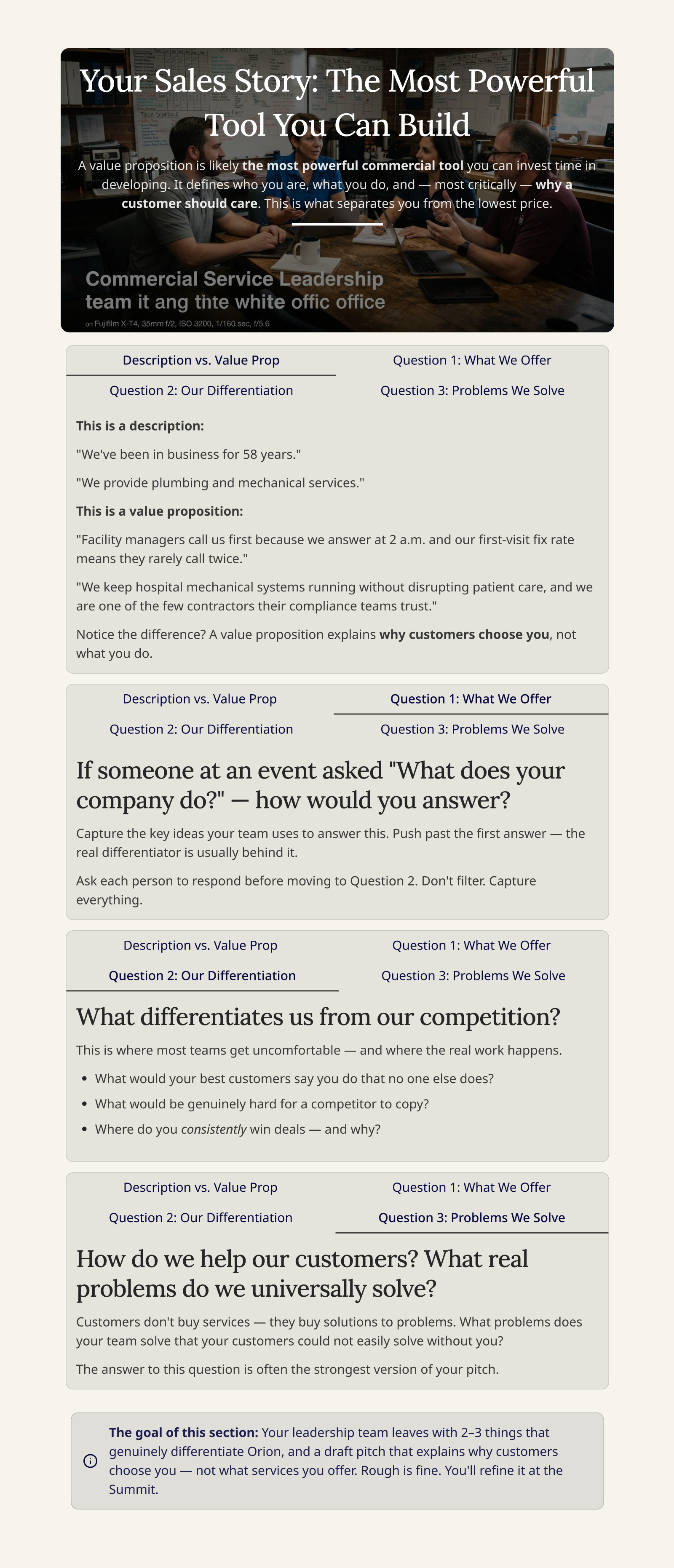
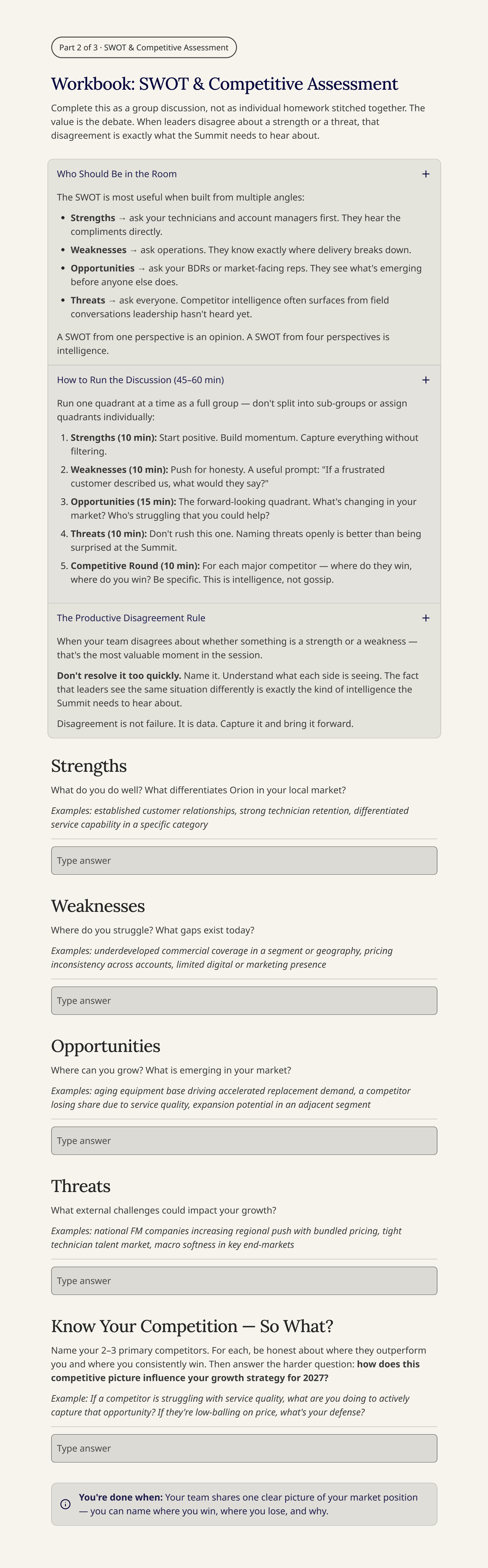
2. Teach the commercial thinking, then have leaders build the plan. Each section teaches the underlying move first (what separates a value proposition a customer pays for from a description of services, why a SWOT built from four vantage points beats one built from the corner office), models it with a worked example, then hands the team a write-in page with judgment-forcing prompts. Leaders leave not just with a completed form but with a shared commercial language they can coach and reuse, so planning capability compounds year over year instead of resetting each Summit.
3. Disagreement is captured as pipeline intelligence, not smoothed over. The "Productive Disagreement Rule" tells teams not to resolve conflict too quickly: when leaders read the same account or market signal as a growth opportunity versus a risk, that split is flagged as exactly what the Summit needs to hear. It applies a core commercial-coaching insight, that the gap in how a team reads its pipeline is where the highest-value strategy conversations live, and makes the session a diagnostic instrument rather than a paperwork exercise.